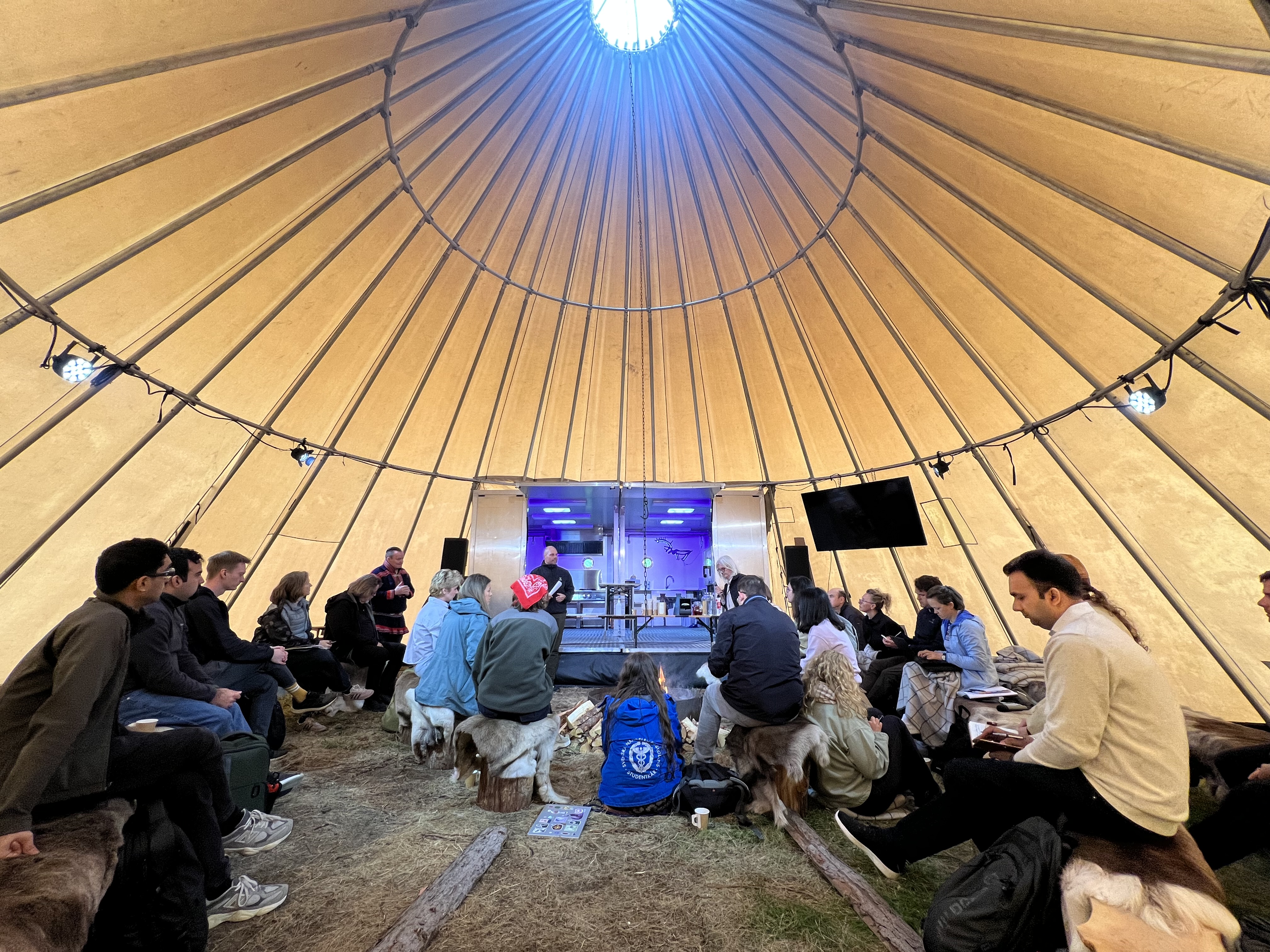
Today 31 PhD students from the Calotte Academy are visiting ICR and NOMAD Indigenous FoodLab to share knowledge and experiences with communities, and foster academic and policy-oriented dialogue among members of the research community and a wide range of other northern stakeholders. The Calotte Acade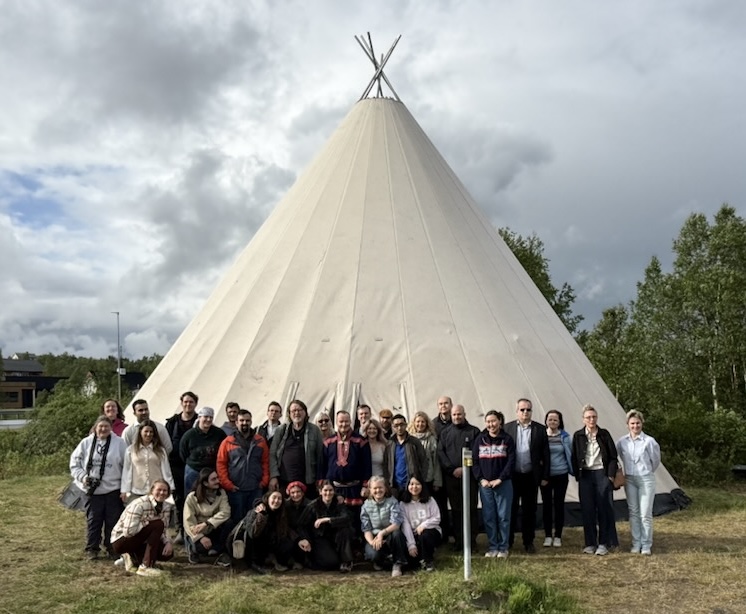 my is an annual traveling symposium and international forum in Europe’s North Calotte region, designed to promote interdisciplinary discourse and implement the interplay between senior and young researchers to train and supervise early-career scientists in circumpolar Arctic studies. UArctic EALAT Institute of ICR is the co-organizer of the symposium.
About the 2026 Calotte Academy
The 2026 Academy, with the theme “Intelligence”, is taking place from 8 to 14 June 2026 in the European Arctic, including sessions in Rovaniemi, Kiruna, Tromsø, Enontekiö, Kautokeino, Inari, and Sodankylä—through Sápmi, the northernmost parts of Finland, Norway, and Sweden. The theme “Intelligence” is inspired from the recent resurgence of the term in particular in the context of the rise of artificial intelligence (AI) or within debates on military intelligence amid increasing geopolitical tension. Yet, the term intelligence is associated with numerous meanings including information or knowledge, cognitive ability, military or espionage, computational intelligence and machine learning, or that of agencies that gather or process secret information. Furthermore, different fields of intelligence may intersect such as the use of AI in data processing within military intelligence.
The theme is also inspired by the observation that global multi-crises are not only geopolitical and ecological, but also crises of intelligence: crises of information, decision-making, sense-making, and knowledge production. The tension between militarization and environmentalization is also a tension between competing epistemologies—strategic intelligence, scientific intelligence, Indigenous knowledge, algorithmic prediction, and human cognitive limits. Similarly, the promise of increasing efficiency through AI to reduce human resource consumption for a more sustainable future led to the paradox of a de-facto constantly growing energy demand to power the world’s data centers, underlining the complex relationships between different fields or understandings of intelligence.
This year’s theme is intentionally broad, inviting contributions from a wide range of disciplines and approaches. The multiple meanings of the term as well as their complex relationships and potentially contradictory effects make it a particularly rich concept for interdisciplinary exploration in and about the Arctic. We therefore invite researchers, students, and young policymakers working on/from the Arctic in fields as varied as International Relations, International Law, Education, Political/Social Sciences, Psychology, Neuroscience, Philosophy, History, Geography, Anthropology, Indigenous Studies, Media Studies, Linguistics, Environmental Humanities, and Data Science.
In an era where information is the lifeblood of governance, science, warfare, and society, what does intelligence mean? How does it shift in times of global disorder, climate urgency, and the development of AI? At the same time, conceptions of intelligence are being transformed—expanded by posthumanist, decolonial, Indigenous, cognitive, and technological perspectives. What forms of knowledge and intelligence are recognized, devalued, weaponized, automated, or extracted in the Arctic and beyond? These are the kinds of questions the Calotte Academy 2026 aims to explore.
Co-organizers
The Calotte Academy 2026 is co-organized by the UArctic TN on Geopolitics and Security and the Northern Policy Society (Finland), in cooperation with (in alphabetic order) Arctic Portal (Iceland); the Department of Media Studies at Stockholm University; the ETS Institute at Luleå Technical University (Sweden); the Faculty of Law at the University of Lapland (Finland); the International Center for Reindeer Herding Husbandry (EALÁT) (Norway); Trent University (Ontario, Canada); and the VERA Centre of Russian and Border Studies at the University of Eastern Finland (Finland).
Lean more here https://www.uarctic.org/news/2026/6/calotte-academy-2026-intelligence/